

Benefits of Copper Peptides for Skin: What the Evidence Shows
Last Updated: November 8, 2026
Quick Summary
Copper peptides are short amino acid chains bound to copper ions, and Copper Tripeptide-1 (GHK-Cu) is the best-known example used in topical skincare. Research on copper peptides is promising for cosmetic benefits like firmness and texture, but most of the evidence comes from laboratory and early-stage studies.
- Copper Tripeptide-1 and GHK-Cu refer to the same ingredient.
- Most copper peptide research comes from lab and cell-culture studies, not human trials.
- Human topical studies show modest, gradual firmness changes over about 8 to 12 weeks.
- Patch test a new copper peptide product before using it on your face more broadly.
- Layer copper peptides with care, and space out acids and retinoids to limit irritation.
Table of Contents
- What Copper Peptides Are and How They Work in Skin
- Copper Peptides and Collagen: Firmness and Elasticity
- Copper Peptides for Skin Wrinkles and Visible Signs of Aging
- Skin Repair, Texture, and Hydration Benefits
- How to Use Copper Peptides in Skincare Routines
- Copper Peptide Side Effects, Irritation, and Patch Testing
- Choosing a Copper Peptide Product: What to Check Next
- Coming Soon: NOCTIS Blue Copper Advanced Daily Face Cream
- Frequently Asked Questions
What Copper Peptides Are and How They Work in Skin
Copper peptides are short chains of amino acids that bind to copper ions, and they are one of the more closely studied peptide families in topical skincare.
In skincare formulations, copper peptides are used to deliver cosmetic benefits such as improved firmness and smoother-looking texture. Researchers have examined how copper peptides may influence skin cell signaling, and the proposed mechanisms are discussed below.
Topical peptides generally have to penetrate the outer layer of the skin to have any effect, which is one reason formulation quality matters.
GHK-Cu and Copper Tripeptide-1 Explained
GHK-Cu and Copper Tripeptide-1 refer to the same ingredient. On ingredient labels, the INCI name Copper Tripeptide-1 is standard in the United States, while GHK-Cu is the shorthand used in much of the research literature. Both point to a copper-binding peptide complex.
Because the same compound may appear under different names, readers comparing products should look for the ingredient itself on the label and check the stated concentration where the manufacturer discloses it.
Copper Peptides and Collagen: Firmness and Elasticity
Collagen and elastin are the structural proteins that give skin its firmness and bounce. Copper is a required cofactor for lysyl oxidase, an enzyme involved in cross-linking collagen and elastin fibers, which is one reason researchers have looked at copper-containing peptides rather than copper alone (pubmed.ncbi.nlm.nih.gov).
That mechanism is real, but it is a mechanism, not proof of a visible result. The evidence for copper peptides and firmness falls into three tiers, and they should not be read as equivalent.
Tier 1: Laboratory and cell-culture research
In fibroblast cultures, GHK-Cu has been reported to influence collagen synthesis and to shift the balance of matrix-building and matrix-breaking activity. These studies are useful for generating hypotheses. They use isolated cells, controlled nutrient baths, and concentrations that may not match what a cream delivers through intact skin. A result in a dish does not automatically translate to a face.
Tier 2: Animal and wound-healing models
Copper peptides have been studied in animal wound-healing models, where the skin barrier is deliberately broken. That is a very different situation from intact, everyday skin. Wound models tell us something about tissue repair biology; they do not establish cosmetic firmness benefits in healthy skin.
Tier 3: Human topical studies
Human evidence exists but is smaller and less uniform than marketing suggests. A common pattern in the published work is a modest, gradual improvement in investigator- or subject-rated firmness and elasticity over roughly 8 to 12 weeks of consistent use, often in studies with small participant numbers and limited controls.
Watch out: when a brand cites "clinical studies" without naming the endpoint, the participant count, or whether the study was controlled, treat the claim as promotional rather than established.
What this means for expectations
Firmer-looking skin from a cosmetic copper peptide product is best framed as a gradual, appearance-based outcome rather than a structural change you can measure at home. Consistency over several weeks matters more than concentration chasing. If firmness is your primary concern, a formula that also supports the skin barrier and hydration will often produce a more noticeable cosmetic difference than a peptide in a thin, drying base, because a well-hydrated barrier looks firmer and more even on its own.
For a broader framework on reading ingredient panels and formulation quality, see our buyer's guide to choosing the best copper peptide cream for face.
Copper Peptides for Skin Wrinkles and Visible Signs of Aging
Fine lines and wrinkles develop from a combination of collagen loss, repeated facial movement, sun exposure and reduced hydration.
It is important to be precise about what this means. Copper peptides are a cosmetic ingredient (the FDA). They may help skin look smoother or more resilient, but they do not reverse biological aging or permanently change skin structure.
For people with deeper wrinkles, topical cosmetics typically provide modest improvements at most. Discussing expectations with a dermatologist can help set realistic goals.
Skin Repair, Texture, and Hydration Benefits
Copper plays a role in several enzymatic processes involved in tissue repair, which is why copper peptides have been studied for wound healing in laboratory settings.
Texture improvements usually come from a combination of ingredients rather than a single active. Read practical overnight strategies for improving skin texture, including barrier-supporting ingredients and hydration techniques. A well-formulated moisturizer supports the skin barrier, and a barrier that holds water tends to look more even and resilient.
How to Use Copper Peptides in Skincare Routines
Copper peptides are typically applied to clean skin in a serum or moisturizer, once or twice daily depending on the product's directions. Follow this step-by-step guide to using a copper peptide serum for hydration. Follow the label for the specific formula, because concentration, texture, and pH vary from product to product.
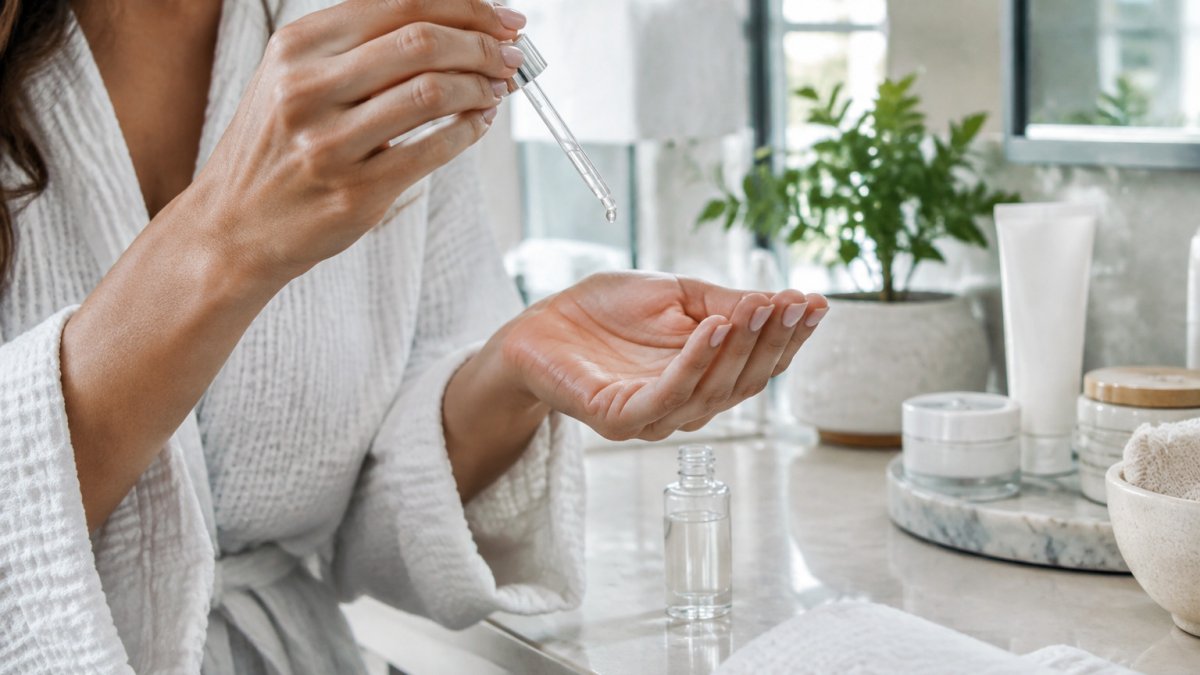
A simple routine looks like this:
- Cleanse with a gentle, non-stripping cleanser.
- Apply the copper peptide product to damp or dry skin, per the label.
- Layer a moisturizer to support the barrier and lock in hydration.
- Apply sunscreen during the day, since UV exposure is a major driver of visible aging.
Consistency matters more than volume. Using more product than directed does not produce faster results and may increase the chance of irritation.
Pairing copper peptides with other actives
This is where most routines go wrong.
Retinoids. Retinol and prescription retinoids can be irritating on their own, and layering them with another active increases that risk.
Exfoliating acids. AHA and BHA products lower skin pH and can sting, especially on skin that is already sensitized.
Watch out: layering several actives at once makes it impossible to tell which product is causing irritation.
Layering order and timing
As a general rule, apply products from thinnest to thickest: cleanser, toner if used, water-based serum, copper peptide serum, moisturizer, then sunscreen in the morning. If your copper peptide product is itself a moisturizer, it takes the moisturizer slot. There is no strong evidence that copper peptides must be applied at a specific time of day; morning or evening both work as long as you use sunscreen during the day.
What to expect and when
Cosmetic changes from copper peptides are typically gradual. Published work often describes improvements over several weeks of consistent use, and individual results vary. Subjective improvements in how skin looks and feels are more commonly reported than instrument-measured changes, and no product can guarantee a specific outcome. If you see no change after a couple of months of consistent use, that is a signal to reassess the formula rather than to apply more.
The table below summarises the basic routine steps and when each one applies.
| Step | What to do | Time or frequency |
|---|---|---|
| Cleanse | Use a gentle, non-stripping cleanser | Morning and evening |
| Apply copper peptide | Use on clean skin as the label directs | Once or twice daily |
| Moisturize | Support the barrier and lock in hydration | After the peptide |
| Sunscreen | Protect from UV exposure | Every morning |
Copper Peptide Side Effects, Irritation, and Patch Testing
Copper peptides are generally considered well tolerated, but mild irritation such as redness, stinging or dryness can occur, particularly in people with sensitive skin or those using multiple active ingredients at once. Learn what signs to watch for, how to patch test safely, and when to discontinue use.
A patch test is a sensible first step. Apply a small amount to a discrete area, such as behind the ear or along the jawline, and observe for 24 to 48 hours before using the product on the face more broadly.
Copper peptides are not a substitute for medical treatment of any skin condition. Anyone with an active skin disease or a known copper sensitivity should seek professional guidance before starting a new product.
Choosing a Copper Peptide Product: What to Check Next
When comparing copper peptide creams, start with the ingredient list and the stated concentration if the brand discloses it. Look for a formula that also includes hydrating and barrier-supporting components, since these help the skin use the product comfortably.
Other useful checks include whether the product is fragrance-free, whether the brand explains its formulation choices clearly, and whether it lists the full ingredient panel. If you are interested in how sleep and skin health fit into a broader wellness routine, NOCTIS Deep Sleep is a melatonin-free nighttime supplement that some readers pair with their evening skincare, though it is not a skincare product and should be evaluated on its own terms. You can browse the current skincare range at shop premium NOCTIS skincare to see the products available today, and our buyer's guide to choosing the best copper peptide cream for face walks through concentration, hydration and barrier support in more detail.

Be cautious of products that promise dramatic or guaranteed results. Cosmetic improvements are usually gradual, and claims should be measured against the evidence.
Coming Soon: NOCTIS Blue Copper Advanced Daily Face Cream
A new kind of copper peptide skincare is coming.
Designed for people seeking:
- Firmer-looking skin
- Smoother-looking skin
- Deep hydration
- Visibly healthier-looking, more resilient skin
Developed without retinol, exfoliating acids, or added fragrance.
NOCTIS Blue Copper Advanced Daily Face Cream is coming soon. Stay tuned for the launch.
Frequently Asked Questions
Can copper peptides be used with vitamin C? Many routines combine them, but formulation matters.
How long does it take to see results from copper peptides? Published cosmetic work typically describes gradual changes over several weeks of consistent use.
Do copper peptides cause irritation? Mild irritation is possible, especially for sensitive skin.
Frequently Asked Questions
What are the downsides of copper peptides?
The most commonly reported downsides are mild irritation, redness, or stinging, particularly for people with sensitive or reactive skin. Formulas that combine copper peptides with other active ingredients can increase the chance of irritation for some users. Human clinical evidence for copper peptides is still limited compared with well-studied topical ingredients, so results vary and are not guaranteed. A patch test on a small area of skin for several days before full-face use is a practical precaution.
Can I use copper peptides every day?
Many skincare formulas containing copper peptides are designed for daily use, and daily application is the typical approach in published product guidance. Starting with once-daily use, often in the morning or evening, lets you see how your skin responds. If irritation develops, reduce frequency and consult a dermatologist. Consistency matters more than heavy application, so following the directions on the product label is the safest starting point.
How long does it take to see results from copper peptides?
Timelines in consumer skincare are not standardized, and published human studies on copper peptides vary in design and duration. Changes in skin appearance, such as perceived smoothness or hydration, may be noticed sooner than changes in firmness or fine lines, which typically require several weeks or longer of consistent use. No product can guarantee a specific timeline, so it is reasonable to evaluate a formula over at least several weeks.
What should you not mix with copper peptides?
Combining copper peptides with strong exfoliating acids, high-strength retinoids, or products with added fragrance may increase irritation for some people. Layering multiple potent actives at once can make it harder to tell which product is causing a reaction. Introducing one new product at a time and keeping the routine simple makes it easier to identify what works for your skin. A dermatologist can help if you have a specific skin condition or sensitivity.
Can copper peptides help skin look firmer or smoother?
Copper peptides are studied for their role in supporting collagen and elastin activity and extracellular matrix health, which relate to skin firmness and elasticity. Some small studies and laboratory research suggest possible effects on skin appearance, but the strength of human evidence is limited and varies by formulation. Realistic expectations are that a well-formulated copper peptide product may support firmer-looking and smoother-looking skin, rather than dramatically changing its structure.
