

7 Fragrance-Free Skincare Picks for Resilient Skin in 2026
Last Updated: November 1, 2026
Quick Summary
The best fragrance-free skincare for resilient skin focuses on a gentle cleanser, a fragrance-free moisturizer applied to damp skin, and daily sun protection. Fragrance-free means no added fragrance, so check the full ingredient list for masking fragrances and scented essential oils.
- Resilient skin means skin that holds moisture and recovers well from everyday stressors.
- Fragrance-free and unscented are not the same, since unscented products may contain masking fragrances.
- Check the full ingredient list for words like fragrance, parfum, or perfume.
- Apply moisturizer to damp skin to help trap water and improve hydration.
- Introduce new products one at a time, waiting about a week between additions.
Table of Contents
- What Resilient Skin Actually Means
- Fragrance-Free Versus Unscented: Why the Label Matters
- How to Read Fragrance-Free Skincare Labels
- Choosing the Best Fragrance-Free Moisturizer
- Fragrance-Free Products for Dry Skin
- Building a Fragrance-Free Skincare Routine
- Start Your Gentle Routine This Week
- Frequently Asked Questions
What Resilient Skin Actually Means
Resilient skin is skin that holds its moisture, resists irritation, and recovers well from everyday stressors such as wind, heat, harsh cleansing, and product reactions.
When the barrier is intact, skin tends to feel comfortable and look even. For a deeper look at evaluating copper peptide creams, see our buyer's guide to choosing the best copper peptide cream for face.
Building resilience is a gradual process. Sleep is one lifestyle factor that may influence how skin looks and recovers, and our article on why quality sleep matters for skin explains the connection.
Fragrance-Free Versus Unscented: Why the Label Matters
These two terms are not interchangeable, and the difference affects how a product may feel on your skin. A fragrance-free product contains no added fragrance ingredients. An unscented product may still contain fragrance, sometimes in the form of masking agents that reduce or cover up the smell of other ingredients.
Masking fragrances are a common source of confusion. A product labeled unscented can contain fragrance ingredients added specifically to neutralize naturally strong odors. For people with sensitive skin, these ingredients may still be relevant, even though the product does not smell noticeably perfumed.
Fragrance-free does not automatically mean allergy-free. Some people react to other ingredients, including certain preservatives, botanical extracts, and essential oils. The label narrows the field, but it does not replace reading the full ingredient list.
How to Read Fragrance-Free Skincare Labels
The ingredient list is the most reliable place to check what a product contains. In the United States, ingredients are listed in descending order of concentration, so ingredients near the top make up the bulk of the formula.
Be aware of a few patterns when reading labels:
- "Fragrance-free" means no added fragrance, but check the full list for scented botanicals.
- "Unscented" may include masking fragrances, so the label alone is not enough.
- Short ingredient lists are not always gentler, because individual sensitivities vary widely.
Patch testing a new product on a small area of skin for several days is a practical way to see how your skin responds before using it more broadly.
Choosing the Best Fragrance-Free Moisturizer
A moisturizer is usually the workhorse of a resilient-skin routine because it does the most direct barrier support. The challenge is that "best" depends on your barrier condition, your climate, and how your skin has responded to past products, not on a single ranking. The most useful approach is to evaluate each fragrance-free moisturizer against a consistent set of criteria so you can compare formulas on their merits.
Start with the ingredient architecture
Most moisturizers combine three functional categories, and understanding them makes label reading much faster:
- Humectants draw and hold water in the upper layers of skin. Common examples include glycerin, hyaluronic acid, sodium PCA, and panthenol. They help skin feel hydrated and plump, but they work best when paired with something that slows water loss.
- Emollients soften and smooth the surface and help fill the tiny gaps between skin cells. Examples include caprylic/capric triglyceride, squalane, shea butter, and various plant oils. They improve how comfortable and flexible skin feels.
- Occlusives form a breathable film that reduces water loss through the skin. Petrolatum, dimethicone, and lanolin are well-known examples. They are especially useful in dry or cold conditions and for overnight use.
A well-built fragrance-free moisturizer usually layers all three. A formula that is heavy on humectants but light on emollients and occlusives may feel hydrating at first and then leave skin tight again within an hour.
Look for barrier-supporting ingredients
Beyond the basic three categories, some ingredients are specifically associated with barrier support:
- Ceramides are lipids that occur naturally in the skin barrier. Formulations that include ceramides alongside cholesterol and fatty acids are designed to resemble the barrier's own lipid mix.
- Niacinamide is widely used in barrier-focused formulas and is generally well tolerated, though some people with very reactive skin prefer to introduce it slowly.
- Panthenol and allantoin are common in soothing, comfort-focused formulas.
None of these ingredients guarantees a result, and finished formulas matter more than any single ingredient. But they are reasonable signals that a product was built with barrier support in mind.
Match the format to your skin and climate
Texture is not a cosmetic detail, it affects how well you will actually use a product.
- Creams are richer and generally suit dry skin, mature skin, and cold or low-humidity conditions.
- Lotions are lighter and often work better for combination or oily skin, or in warm, humid weather.
- Ointments and balms are the most occlusive and are useful for very dry patches or overnight slugging, but they can feel heavy under sunscreen or makeup.
A practical approach is to keep one lighter fragrance-free lotion for daytime and one richer fragrance-free cream for evening, then adjust seasonally.
Screen the full ingredient list, not just the front label
A fragrance-free claim on the front of the package is a starting point, not a conclusion. Check the ingredient list for:
- The words fragrance, parfum, or perfume.
- Named essential oils and their components, such as lavender oil, citrus peel oil, limonene, linalool, eugenol, and citronellol, which are common fragrance allergens.
- Masking fragrances, which sometimes appear in products labeled unscented.
Photograph the ingredient list of any product you are considering and compare it side by side with products you already tolerate. Patterns in the first five to eight ingredients tell you more about how a formula will behave than marketing copy does.
Evaluate cost per use, not jar size
A larger jar is only a better value if you will finish it before it expires and if the formula suits your skin. Two practical checks:
- Look at the PAO symbol (the small open-jar icon) for the period-after-opening in months. A 12M product that takes you 18 months to finish is not a savings.
- Compare cost per ounce across sizes of the same product rather than across brands, since formulations differ too much for cross-brand price comparisons to be meaningful.
Watch for claims that outrun the category
Moisturizers are cosmetics. Language about "repairing" or "reversing" damage should prompt a closer look, because cosmetic products are intended to support the appearance and comfort of skin, not to treat conditions.
This guide does not rank or recommend competing brands. Use the criteria above, ingredient architecture, barrier-supporting ingredients, format fit, full-list screening, and realistic cost per use, to evaluate each fragrance-free moisturizer on its own merits.
The table below summarises the ingredient categories a fragrance-free moisturizer typically layers, and what each one does.
| Ingredient category | Examples | Main role |
|---|---|---|
| Humectants | Glycerin, hyaluronic acid, sodium PCA, panthenol | Draw and hold water in the upper skin layers |
| Emollients | Caprylic/capric triglyceride, squalane, shea butter | Soften skin and fill gaps between cells |
| Occlusives | Petrolatum, dimethicone, lanolin | Form a breathable film that reduces water loss |
| Barrier-supporting | Ceramides, niacinamide, panthenol, allantoin | Mirror or support the skin barrier's lipid mix |
Fragrance-Free Products for Dry Skin
Dry skin and dehydrated skin are often used interchangeably, but they point to different needs. Dry skin generally lacks oil, so it benefits from emollients and occlusives that reinforce the lipid barrier. Dehydrated skin lacks water in the upper layers, so it responds best to humectants applied to damp skin and sealed in. Many people have both at once, especially in winter or after harsh cleansing, which is why the most effective fragrance-free routines for dry skin combine all three functional categories rather than relying on a single hero ingredient.
What to look for in a fragrance-free moisturizer for dry skin
A formula built for dry skin typically includes:
- Humectants near the top of the list, glycerin, hyaluronic acid, sodium PCA, panthenol, or urea. Glycerin in particular appears in a large share of well-tolerated moisturizers because it is effective and generally gentle.
- Emollients that soften without heaviness, squalane, caprylic/capric triglyceride, shea butter, jojoba, or ceramide-rich blends.
- Occlusives that reduce water loss, petrolatum, dimethicone, or lanolin. Petrolatum is one of the most effective occlusives available and is generally well tolerated, though some people prefer to avoid it for texture reasons.
A fragrance-free cream or balm is usually a better fit than a lotion for very dry skin, because lotions are water-heavy and provide less occlusion.
Layer products in the right order
The order in which you apply products affects how much water your skin actually holds:
- Cleanse gently with a low-foaming, fragrance-free cleanser. Hot water and high-foam surfactants strip lipids that dry skin can ill afford to lose.
- Apply a humectant serum or toner to damp skin, within about a minute of cleansing, before skin fully dries.
- Seal with a fragrance-free moisturizer while skin is still slightly damp, so the emollients and occlusives can trap the water underneath.
- Add an occlusive balm or petrolatum on very dry areas, cheeks, around the nose, lips, especially overnight.
- Finish with broad-spectrum sunscreen in the morning. Sun exposure can worsen dryness and uneven tone over time.
The single most impactful change for most dry-skin routines is applying moisturizer to damp skin rather than dry skin. It costs nothing and consistently improves how hydrated skin feels.
Adjust for the season and your environment
Dry skin is often as much about context as it is about genetics. Indoor heating in winter lowers humidity and increases water loss through the skin; air conditioning does something similar in summer. Practical adjustments include:
- Switch to a richer cream or add an occlusive layer during cold months or in low-humidity climates.
- Use a humidifier in bedrooms and workspaces during heating season.
- Shorten showers and lower the water temperature, long, hot showers are a common and underrecognized driver of dryness.
Patch test and introduce slowly
Even fragrance-free products can cause irritation in some people, particularly if they contain essential oils, exfoliating acids, or high concentrations of active ingredients. Introduce one new product at a time and patch test on a small area, the inner forearm or jawline, for several days before applying it more broadly. If skin stings, burns, or develops redness, stop and simplify the routine before trying again.
When dryness does not improve
Persistent dryness, cracking, itching, or redness that does not respond to a consistent fragrance-free routine may have an underlying cause that cosmetic products are not designed to address. In that case, it is reasonable to consult a healthcare professional rather than continuing to add products.
This section does not recommend specific brands. Use the ingredient categories, layering order, and seasonal adjustments above to evaluate fragrance-free options for dry skin on their own merits.
Building a Fragrance-Free Skincare Routine
A simple routine is easier to maintain and easier to troubleshoot than a long list of products. A basic fragrance-free routine usually includes:
- A gentle cleanser used once or twice daily.
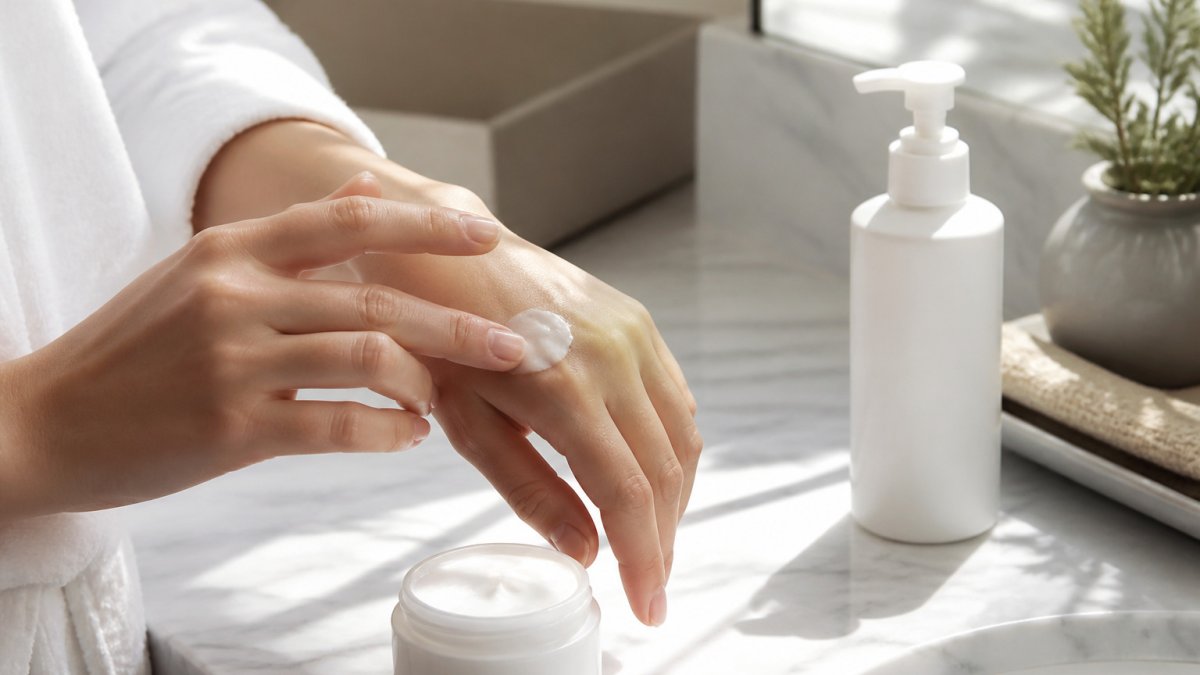
- A fragrance-free moisturizer applied to damp skin.
- Daily sun protection using a broad-spectrum sunscreen in the morning.
Introduce new products one at a time, waiting about a week between additions. This makes it easier to identify what helps and what causes irritation.
Start Your Gentle Routine This Week
Resilient skin is built through consistency, not a single product. Start by checking the ingredient lists of the products you already use, looking specifically for added fragrance. Then choose one gentle cleanser and one fragrance-free moisturizer, and give your skin a few weeks to respond.
Noctis Health Labs publishes practical guides like this one to help readers make informed choices about skincare and wellness. If you are also looking to support your evening routine, you can learn more about NOCTIS Deep Sleep, a melatonin-free nighttime supplement designed to support relaxation as part of a consistent bedtime routine.
Frequently Asked Questions
What does fragrance-free mean on a skincare label?
Fragrance-free means the product contains no added fragrance ingredients, whether synthetic or natural essential oils used to scent it. The FDA does not define the term for cosmetics, so brands can use it loosely. Check the ingredient list for words like fragrance, parfum, or essential oil blends. A product labeled unscented may still contain masking fragrance, so reading the full ingredient list is the most reliable way to tell the difference.
How can I build a fragrance-free skincare routine?
Start with a gentle, fragrance-free cleanser, a simple moisturizer, and a broad-spectrum mineral sunscreen if you spend time outdoors. Introduce one new product at a time and wait a week or two before adding another, so you can identify any reaction. Patch testing a small area of skin before full use is a practical habit for reactive skin. Keeping the routine short makes it easier to stay consistent.
Which skincare ingredients support a healthy-looking skin barrier?
Ingredients such as ceramides, glycerin, and fatty acids are commonly included in moisturizers designed to support the skin barrier. Humectants like glycerin help draw moisture into the skin, while occlusives and emollients help reduce water loss. Results vary by person and skin condition, and a fragrance-free formula is only one part of a gentle routine. Persistent redness, burning, or irritation should be evaluated by a dermatologist.
Can fragrance-free skincare help skin look more resilient?
Fragrance-free skincare can help reduce the chance of irritation for people with reactive skin, which may make skin look calmer and more even over time. It cannot repair damage or change skin structure on its own. Consistent hydration, gentle cleansing, and sun protection matter as much as the formula. Any visible improvement depends on the individual and how their skin responds.
