

How to Build a Bedtime Routine for Frequent Travelers
Last Updated: November 24, 2026
Quick Summary
Build a bedtime routine for frequent travelers by keeping three anchors steady wherever you land: a fixed wind-down sequence, controlled light, and a repeatable room setup. Run the same short ritual in every hotel room, dim lights an hour before bed, and spend five minutes resetting the room on arrival.
- Shift bedtime 15 to 30 minutes toward destination time for three to four nights before departure.
- Keep your wake time fixed once you land, even on day one.
- Pack your sleep kit by routine step so nothing gets forgotten.
- For one- to two-night trips, keep your home schedule instead of shifting your clock.
- Avoid alcohol as a sleep aid, since it tends to fragment sleep later in the night.
Table of Contents
- How Do You Build a Bedtime Routine for Frequent Travelers?
- How to Adjust Your Sleep Schedule for Travel
- Build a Portable Sleep Routine You Can Pack
- How to Sleep Better in a Hotel Room
- How to Beat Jet Lag When You Get Home
- Separate Routines for Short Trips, Long Stays, and Overnight Travel
- What to Do When the Routine Fails
- Make Your Next Trip the One Where Sleep Holds
- Frequently Asked Questions
How Do You Build a Bedtime Routine for Frequent Travelers?
Building a bedtime routine for frequent travelers means keeping three anchors steady no matter where you land: a fixed wind-down sequence, controlled light, and a consistent sleep environment. Travelers who rebuild the same small ritual in every hotel room sleep better than those who chase a perfect schedule. This guide from Noctis Health Labs breaks the process into repeatable steps.
The stakes are real. Sleep disruption is one of the most common complaints among frequent travelers, and the CDC guidance on jet lag and travel sleep notes that crossing time zones can throw off the body's internal clock for days. Below, you'll find a routine you can pack in a carry-on.
Why Travel Breaks a Good Sleep Schedule
A home routine works because your bedroom cues it: same light, same temperature, same pillow. Travel strips all three away in one afternoon.
The result is a bedtime routine that collapses the moment you check in. Your body still runs on home time, the room is too bright, warm, or noisy, and unfamiliar surroundings keep your brain on alert.
The Three Anchors of a Travel-Proof Routine
Anchor 1: A fixed sequence. Same steps, same order, every night. Brush teeth, dim lights, stretch, read. The steps matter less than the repetition.
Anchor 2: Light control. Light is the strongest signal your body uses to set its clock (Circadian Rhythms).
Readers building the supplement side of that routine can review options that support a consistent bedtime routine alongside these anchors.
How to Adjust Your Sleep Schedule for Travel
Adjusting your sleep schedule for travel starts before you leave: shift bedtime and wake time gradually toward your destination's clock, beginning a few days out.
The body adjusts roughly one time zone per day when light exposure and meal timing cooperate. A three-zone trip is manageable in a few days; a ten-zone trip is not something you fix in one night.
Eastbound Versus Westbound: Different Directions, Different Plans
Eastbound travel compresses your day, so your body wants to stay up later than local bedtime. Westbound travel stretches it, so you wake too early.
- Eastbound: move bedtime 15 to 30 minutes earlier each night for three to four nights before departure. Seek morning light at your destination and avoid late-afternoon light.
- Westbound: push bedtime later by the same small steps. Seek evening light on arrival and keep morning light dim for the first day or two.
- Either direction: keep your wake time fixed once you land, even on day one.
A Day-by-Day Pre-Trip Protocol
Use this sequence for any trip crossing three or more time zones.
- Four days out: set a target bedtime and wake time in destination local time. Note the gap between that and your current schedule.
- Three days out: shift bedtime by 15 to 30 minutes toward the target. Keep wake time fixed or shift it by the same amount.
- Two days out: repeat the shift. Start moving meals 30 to 60 minutes toward destination mealtimes.
- One day out: hold the new schedule. Pack the sleep kit and set out travel clothes so departure morning is calm.
- Travel day: set your watch to destination time at boarding. Eat and sleep on destination time as much as the flight allows.
- Arrival day: get outside in daylight within an hour of landing if it is daytime locally. Stay awake until a reasonable local bedtime, even if that means a short walk to push through the slump.
The National Sleep Foundation's guidance on jet lag recommends aligning meals and light exposure with local time as soon as you arrive. Meal timing is an underrated clock signal, and it is often easier to control than light in a hotel.
Jet Lag Versus Ordinary Travel Disruption
Not every bad night on the road is jet lag, and the fix differs.
- True jet lag follows rapid travel across multiple time zones. The body clock is out of phase with local time, and symptoms ease as the clock resets over several days.
- Ordinary travel disruption comes from late arrivals, early departures, unfamiliar rooms, noise, and disrupted meals. The clock may be fine; the environment and schedule are not.
If you land in the same time zone and still sleep badly, the problem is your routine and room setup, not your circadian clock. If you cross several zones and feel alert at 2 a.m. local time, that is the clock, and light exposure plus a fixed wake time is the lever.
Short Trips Versus Long Stays
The length of the trip changes whether a schedule shift is worth it.
- One to two nights: do not attempt a full clock shift. Keep your home schedule as closely as the trip allows and protect sleep with light and noise control.
- Three to five nights: shift partially. Aim for local wake time and accept a slightly early or late bedtime for the first two days.
- A week or more: shift fully to local time. Adjust bedtime gradually, eat on local hours, and treat the hotel room like a bedroom.
Readers building the wind-down side of that schedule can review options that support a consistent bedtime routine alongside these timing steps.
Build a Portable Sleep Routine You Can Pack
A portable sleep routine is a short, fixed set of steps you can repeat in any room in under 30 minutes. The goal is familiarity, not perfection.
- Unpack and set out tomorrow's clothes, so your mind stops tracking tasks.
- Dim every light source and close the curtains.
- Take a warm shower to help your body cool down afterward.
- Do five minutes of slow breathing or gentle stretching.
- Read paper or a dimmed screen, never bright notifications.
- Keep the same lights-out time you use at home.
For a deeper set of wind-down steps to adapt, see this nighttime wind down routine.
Your Travel Sleep Kit, Organized by Routine Step
Pack by step, not by category. That way nothing gets forgotten.
| Routine Step | What to Pack | Why It Helps |
|---|---|---|
| Wind-down | Lavender sachet, paperback book | Signals the brain that the day is closing |
| Light control | Sleep mask, blackout clips | Blocks light you can't switch off |
| Noise control | Earplugs, headphones, white noise app | Covers hallway and street noise |
| Comfort | Travel pillow, breathable sleepwear | Recreates familiar bedding feel |
| Hydration | Refillable water bottle | Keeps hydration steady without late caffeine |
A common mistake is packing sleep aids but not a way to block light. Light wins the fight almost every time.
How to Sleep Better in a Hotel Room
To sleep better in a hotel room, spend five minutes resetting the room before bed: block light, cut noise, cool the space, and remove visual clutter. Sequence the setup so it happens on arrival, not at 11 p.m. when you are already frustrated.
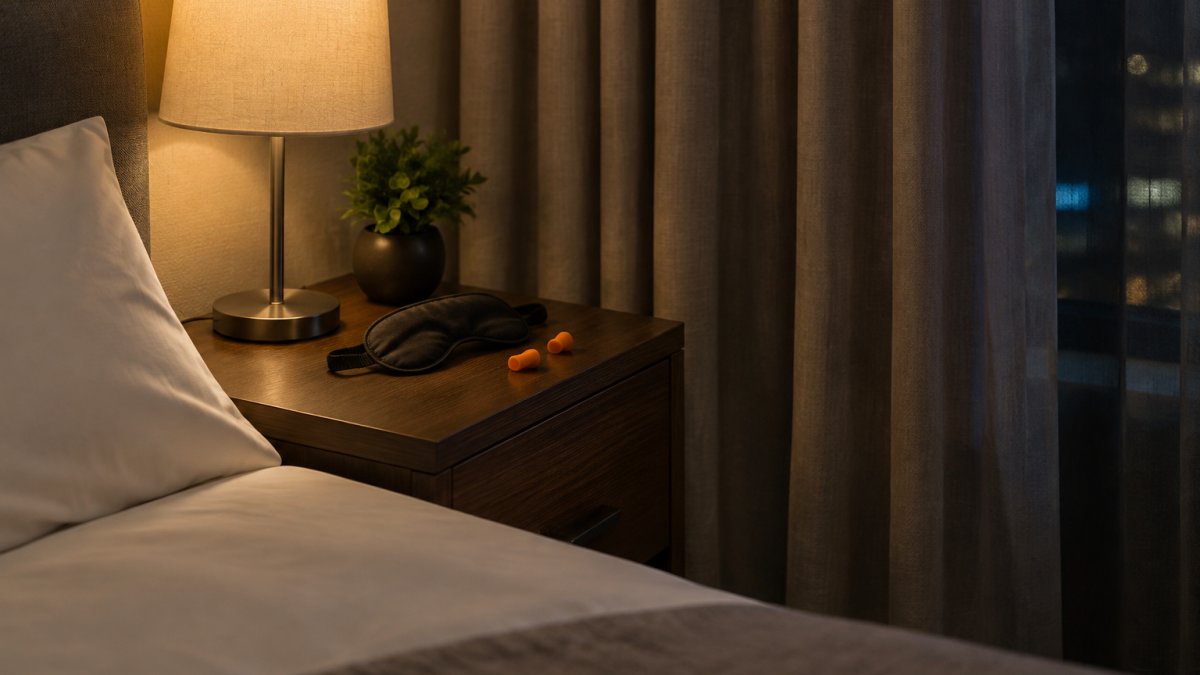
Hotel rooms fight sleep in predictable ways. Hallway light leaks under the door. The thermostat sits behind a curtain. The bedding is either too heavy or too thin. The fix is a repeatable setup that runs the same way in every room.
The Arrival-to-Bed Setup Sequence
Run this in order the moment you check in. The early steps take a minute and prevent the late-night scramble.
- On arrival, before unpacking: close the blackout curtains and check for gaps at the edges. Roll a towel against the bottom of the door if hallway light leaks through.
- Set the thermostat now, not at bedtime. Cooler rooms support sleep for most people; set it a few degrees below what feels comfortable on entry and let the room settle.
- Locate the light sources. Find the TV standby light, the smoke-detector LED, and any charging indicators. Cover or unplug what you can.
- Stage the nightstand. Put the sleep mask, earplugs, and water bottle within reach so you are not searching in the dark.
- Silence the phone. Set it to silent and face-down, and set a wake alarm for local time.
- Lay out sleepwear and tomorrow's clothes. This closes the day and removes morning decisions.
- Run your wind-down sequence at the same local hour you use at home.
Room-Type Contingencies
Not every room cooperates. Plan for the common problem rooms.
- Street-facing room: request a move at check-in if traffic noise is audible. If no move is available, earplugs plus a white noise app cover most street noise.
- Room near the elevator or ice machine: ask for a room away from both when you book, and confirm at check-in.
- Room with heavy curtains that do not fully close: a sleep mask handles the gap the curtains leave.
Shared Rooms and Accessibility Needs
A room setup that ignores the other person in the bed is not a routine; it is a negotiation waiting to fail.
- Traveling with a partner or colleague: agree on lights-out time and noise preferences before the trip. A sleep mask and earplugs let one person read while the other sleeps.
- Light or noise sensitivity: pack the mask and earplugs every trip, not just when you expect a noisy room.
- Medication routines: keep any nighttime medication in the same staged spot on the nightstand so the routine does not break when the room is unfamiliar.
Travelers who struggle specifically with unfamiliar rooms can review how to sleep better without melatonin for more strategies.
A Five-Minute Destination Room Setup Checklist
Run this the moment you arrive, not at bedtime.
- Close blackout curtains and clip gaps shut
- Roll a towel against the door if hallway light leaks through
- Set the thermostat cooler than you think you need
How to Beat Jet Lag When You Get Home
Beating jet lag at home means resisting the urge to sleep in. Get up at your normal local time, get outside in morning light, and keep your bedtime routine intact for several days. Recovery takes longer than most people expect.
- Avoid long naps on day one. Keep any nap under 20 minutes.
- Eat meals at home-time hours immediately.
- Take a short walk in daylight within an hour of waking.
If sleep still feels off after a week, that's worth mentioning to a clinician. Persistent sleep disruption after travel can have causes beyond jet lag.
Separate Routines for Short Trips, Long Stays, and Overnight Travel
One routine doesn't fit every trip. Short trips, long stays, and overnight travel each need a different plan.
Short trips of one to two nights. Keep the sequence but drop the extras. Sleep mask, earplugs, lights out. Don't try to shift your clock for a two-night trip; it costs more than it gains.
Overnight travel. Sleep in blocks. Use a mask and earplugs on the plane, skip alcohol, and set your watch to destination time at boarding.
Frequent work travel. Standardize everything. Same kit, same sequence, same lights-out hour in local time. Consistency is the whole strategy.
What to Do When the Routine Fails
The routine will fail sometimes. A delayed flight, a noisy floor, a late dinner. What matters is the recovery plan.
Start with the most likely culprit. If you can't sleep, ask which anchor broke: sequence, light, or room setup.
- Racing thoughts: write tomorrow's tasks on paper, then close the notebook.
- Noise: earplugs plus a fan or white noise app.
- Light: sleep mask, even if the curtains look closed.
Watch out: reaching for alcohol as a sleep aid backfires. It may speed sleep onset but tends to fragment sleep later in the night.
Make Your Next Trip the One Where Sleep Holds
Travel sleep rarely fails because of one bad night. It fails because the routine never travels with you.
Noctis Health Labs built NOCTIS Deep Sleep for exactly this kind of nightly ritual.
Readers ready to build that routine can explore the melatonin-free sleep supplement and see how it fits a travel kit.

Consistent sleep on the road comes down to a routine you can rebuild anywhere.
Frequently Asked Questions
How long does it take to adjust to a new time zone?
Most people shift roughly one hour per day when they actively manage light exposure, meals, and bedtime. That means a three-hour change usually takes about three days, and a trip from the East Coast to Europe can take close to a week to feel normal. You can shorten that window by getting morning light at your destination, eating meals on local time, and moving your bedtime in small steps rather than trying to force a full jump the first night.
What should I include in a portable bedtime routine?
Keep it to items that recreate your home wind-down in a smaller form: a sleep mask, earplugs or headphones, a travel pillow, comfortable sleepwear, and any supplement you already take nightly. Add a short screen-free wind-down, like reading a few pages or a few minutes of slow breathing. The goal is a portable sleep routine you can repeat in any room, so pack by routine step rather than by category and keep the kit packed between trips.
Should I keep my usual bedtime when traveling?
Keep the routine, flex the clock. Your wind-down sequence, the order of your steps, and your wake-up habits should stay the same, but the actual bedtime should move toward local time as quickly as your schedule allows. For a one- or two-hour shift, go straight to local bedtime. For larger jumps, split the difference on the first night and let morning light do the rest of the work over the following days.
How can I beat jet lag when I get home?
Treat the return trip like a second adjustment, not a recovery. Get outside in morning light on your first few days home, eat meals at your normal local times, and go to bed at your usual hour even if you are tired early. Avoid long naps longer than about 20 minutes, and keep your evening wind-down intact. If you take a melatonin-free sleep supplement as part of your routine, resume it at your home bedtime rather than at the time you were sleeping on the road.
